Showing posts with label kawasaki. Show all posts

Thursday, December 9, 2010

Kawasaki Z1000 SX (2011)


It could be baptized “the moment of dark green . ” In the days before the INTERMOT 2010 seems to confirm that the news will not be limited to 2011 colors and that the well known Z750R will not be the only player in the spotlight of Cologne.


Emerge from the network – and more precisely by SoyoMotero.net – some pictures and the first technical details about the new Z1000SX, Unpublished version of the faired maxi -naked Akashi which now caters to an audience too sporty, but that does not disdain more protectiveness and use your bike for travel in the medium -long range .


The new aesthetics is clear: the windshield of a good size is also adjustable, raised handlebars , while the hull with fin is very aggressive . Less sophisticated design of the rear, where the handles and the optics look very much like that of twin ER -6.
All new instrumentation, which combines an analog part (the revolution ) to a digital , which offers all the information on the onboard computer and its functions .


Under the tank ( 19 liters ) houses the 4-cylinder DOHC 16-valve 1043 CC 138 Hp who vents his voice through the exhaust system 4-2-2 amended, with a smaller volume of 3 liters compared to that of the Z1000 , and above 3.5 kg less weight .


Kawasaki Z1000 (2011)


The Z1000 thrills before you even jump aboard, with some of motorcycling’s most rakishly stunning lines and body shapes. The aesthetic showcase begins with a low-mount front cowl that slopes back radically, highlighting the Z’s prow and, behind it, an adjustable instrument cluster featuring a multifunction LCD display covered by a trick-looking orange lens. The headlight represents Kawasaki’s first-ever use of a line-beam unit, the guts of which are integrated nicely into that angled cowl. Moving rearward, you come to a shapely fuel tank that’s flared on the sides to let you grab it with your knees and that’s trim at the back for a snug fit. The seat is low and narrow at the front to make ground contact easy, and flows beautifully rearward to end in a futuristically retro LED taillight behind a red lens. It’s a thoroughly athletic shape, one sure to garner attention wherever it’s ridden.


Totally redesigned just last year, the Z features a wide range of new-think moto technology, including an aluminum frame similar to the ZX™-10R’s that curves over the engine, cradling it from above. The design allows a narrow mid-section, which fosters a high degree of rider comfort and feedback in addition to keeping weight low and chassis rigidity high. The engine bolts solidly to the frame in three places, stressed-member-style, and there’s also a rubber mount at the upper rear crankcase area for added vibration damping and torsional rigidity. The main frame and swingarm pivot elements are cast as a single unit, with welds eliminated wherever possible for a more aesthetically pleasing look. And the subframe is a lightweight aluminum die-casting, which is light, smooth and beautiful.


Suspension at both ends is thoroughly modern and wickedly functional: a beefy, fully adjustable 41mm inverted fork up front and a spring preload and rebound damping adjustable horizontal back-link shock is mounted above the swingarm to shield it from exhaust heat and foster an added degree of mass centralization. Wheel control is simply superb, and the substantial feedback sent to the rider makes it easy to know exactly what’s going on at the bike’s contact patches.


The heart of every naked bike is its engine, so Kawasaki engineers paid special attention here for maximum, arm-straightening impact: Dual cams. Sixteen valves. 1,043cc. Liquid cooling. High compression. A long stroke – 56mm – for instantaneous thrust. Six speeds. And digital fuel injection. It’s all there.


Kawasaki Z 1000 Features:

Year
2011

Engine
Liquid cooled, four stroke, transverse four cylinder, DOHC, 4 valve per cylinder.

Capacity
1043
Bore x Stroke 77.0 x 56.0mm
Compression Ratio 11.8:1

Induction
DFI® with four 38mm Keihin throttle bodies, oval sub-throttles

Ignition / Starting
TCBI with digital advance / electric

Transmission / Drive
6 Speed / chain
Frame Type: Aluminum Backbone
Rake/Trail 24.5 degrees / 4.1 in.

Front Suspension
41mm inverted cartridge fork with stepless compression and rebound damping, adjustable spring preload / 4.7 in wheel travel

Rear Suspension
Horizontal monoshock with stepless rebound damping, adjustable spring preload / 5.4 in wheel travel.

Front Brakes
2x 300mm discs 2 piston caliper

Rear Brakes
Single 250mm disc 1 piston caliper

Front Tyre
120/70 -R17

Rear Tyre
190/50 ZR17
Seat Height 815.3 mm / 32.1 in.

Fuel Capacity
15.5 Litres / 4.1 lb
Consumption average 17.1 km/lit

Standing ¼ Mile
11.1 sec

Top Speed
239.7 km/h


Kawasaki Z1000 (2009)


Primed to once again set the performance naked bike class ablaze, the Kawasaki Z1000 for 2008 received seriously bulked up performance and styling . Whilst it's price has been seriously reduced for 2009 with the ABS model now being reduced in price to the old Non ABS price. For 2009 ABS will be the only model available. The aggressive aesthetics of this machine directly mirrors its ferocious performance. With the engine and chassis characteristics of the Kawasaki Z1000 refocused for serious street riding, the new model more than takes up where its predecessor left off – it redefines what pure naked performance really is all about.


Power
The engine of the Kawasaki Z1000 has been tuned to satisfy the most demanding big-bore power riders, with torque boosted, particularly in the low- to mid rev-range to provide loads of muscle when and where it’s most needed. Even from cruising speeds a twist of the throttle really delivers the goods, and the engine will keep on pulling hard right through the rev range.


Control
For 2008 the new Kawasaki Z1000 received a new engine sub-frame and re-engineered chassis rigidity which provides truly outstanding feedback, enabling the street rider to instantly read and respond to the bike’s behaviour in all speed ranges. Further enhancing rider-machine synergy are improved mass centralisation and revised ergonomics, with handlebars positioned closer to the rider and a slimmer seat resulting in a compact riding position which allows the rider to take full advantage of the Kawasaki Z1000 ’s greater stability and sharp, nimble handling qualities.


Style
With pure aggression emanating from the very core of the Kawasaki Z1000, it is not at all surprising that its performance levels are in turn reflected in this bike’s fierce styling and sheer physical presence. The crouching, muscular appearance of the new Z1000 is direct testimony to the bike’s potency. It’s stance is as that of the body of a conditioned athlete poised to explode from the blocks.


Kawasaki Z1000 2009 Features:

Engine type Liquid-cooled, 4-stroke In-Line 4
Displacement 953 cm³
Bore x stroke 77.2 x 50.9 mm
Compression ratio 11.2:1
Valve/Induction system DOHC, 16 valves
Maximum power 92 kW {125 PS} / 10,000 rpm
Maximum torque 98.7 N·m {10.1 kgf·m} / 8,200 rpm
Fuel system Fuel injection: ø36 mm x 4 (Keihin) with oval sub-throttles
Ignition Digital
Starting Electric
Lubrication Forced lubrication, wet sump
Transmission 6-speed, return
Final Drive Sealed chain
Primary reduction ratio 1.714 (84/49)
Gear ratios: 1st 2.571 (36/14)
Gear ratios: 2nd 1.882 (32/17)
Gear ratios: 3rd 1.556 (28/18)
Gear ratios: 4th 1.333 (28/21)
Gear ratios: 5th 1.200 (24/20)
Gear ratios: 6th 1.095 (23/21)
Final reduction ratio 2.667 (40/15)
Clutch Wet multi-disc, manual
Frame type Tubular backbone (with engine sub-frame), high-tensile steel
Rake/Trail 24.5° / 103 mm
Suspension, front 41 mm inverted fork with stepless rebound damping and spring preload adjustability
Suspension, rear Bottom-Link Uni-Trak with gas-charged shock,
stepless rebound damping and spring preload adjustability
Wheel travel, front 120 mm
Wheel travel, rear 150 mm
Tyre, front 120/70ZR17M/C (58W)
Tyre, rear 190/50ZR17M/C (73W)
Brakes, front Dual semi-floating 300 mm petal discs
Brakes, rear Single 250 mm petal disc
Steering angle, left / right 31° / 31°
Dimensions (L x W x H) 2,090 mm x 780 mm x 1,065 mm
Wheelbase 1,445 mm
Ground Clearance 160 mm
Seat height 820 mm
Fuel capacity 18.5 litres

Wednesday, December 8, 2010

Sanctuary RCM


Sanctuary RCM Kawasaki Z1-R

Mention Japanese customs based on Kawasaki and the name Sanctuary will pop up. Like Bull Dock, Sanctuary modifies the Z1 and other models like the older Ninjas but they also apply their magic to the Suzuki Katana and the Honda CB1100F. High end components throughout, brakes, suspension and new swing arms plus lots of frame strengthening and engine work results in their RCM line, the Real Complete Machine. Vintage machines with all modern components, these bikes look great but they're not just show, Sanctuary races what they build.

Like shops here in the U.S. customizing and rebuilding old Harleys, over in Japan, you have a strong support community for reworking the old Japanese standards and superbikes. The look is refined and they seem to have all of the weak spots worked out. Obviously, going this route isn't cheap, high quality work never is, but if your taste runs along the lines of the old Z1, Sanctuary might have what you're looking for.


Sanctuary RCM Kawasaki Z1-R


Sanctuary RCM Kawasaki Z1-R


Sanctuary RCM Kawasaki Z1-R

Sanctuary RCM Kawasaki Z1-R


Mention Japanese customs based on Kawasaki and the name Sanctuary will pop up. Like Bull Dock, Sanctuary modifies the Z1 and other models like the older Ninjas but they also apply their magic to the Suzuki Katana and the Honda CB1100F.


High end components throughout, brakes, suspension and new swing arms plus lots of frame strengthening and engine work results in their RCM line, the Real Complete Machine. Vintage machines with all modern components, these bikes look great but they're not just show, Sanctuary races what they build.Like shops here in the U.S. customizing and rebuilding old Harleys, over in Japan, you have a strong support community for reworking the old Japanese standards and superbikes.


The look is refined and they seem to have all of the weak spots worked out. Obviously, going this route isn't cheap, high quality work never is, but if your taste runs along the lines of the old Z1, Sanctuary might have what you're looking for.


Tuesday, October 19, 2010

Kawasaki ZX -14


Kawasaki Ninja ZX-14 Features:

Engine Type: 4-Stroke Head, 4-Cylinder, Liquid-Cooled, DOHC.
Displacement: 1352 cc
Bore & Stroke: 84.0 x 61.0 mm
Maximum torque: 113.5 pounds-ft / 7500 rpm
Compression ratio: 12.0:1
Fuel Injection: DFI with Mikuni 44mm Throttle Bodies (4)
Ignition: TCBI with Digital Advance
Transmission: 6-Speed
Final Drive: X-Ring Chain
Rake / Trail: 23 degrees / 94 mm.
Front Wheel Travel: 4.6 in
Rear Wheel Travel: 4.8 in
Tire size front: 120/70 ZR17
Rear Tire Size: 190/50 ZR17
Wheelbase: 57.5 ins
Overall Height: 46 ins
Overall Length: 85.4 ins
Overall Width: 29.9 ins
Front Suspension: 43 mm Inverted Cartridge Fork
Preload, Stepless: Rebound and Compression damping
Rear Suspension: Uni-contract with Adjustable Preload
Front Brake Type: Dual Semi-Floating Petal Disc
Rear Brake Type: Single Petal Disc
Fuel Tank Capacity: 5.8 gal.
Seat Height: 31.5 ins
Dry Weight: 474 lbs.

Saturday, August 14, 2010

KAWASAKI EDGE SPECIFICATION

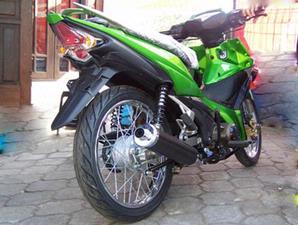
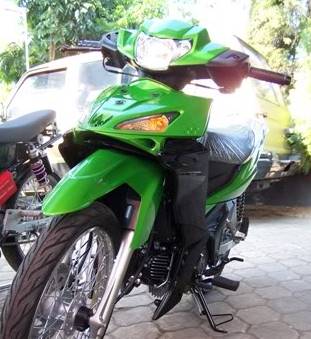
kawasaki edgekawasaki back again launched a new motorcycle in Indonesia is kawasaki edge. which has a 112cc engine capacity. This motor is likely to be pesain from yamaha vega in 112cc motorcycle class. for more details about the specification of kawasaki edge. please see below.

kawasaki edge
Specification of Kawasaki Edge :

Engine type: 4 stroke, SOHC 2 Valves
Diameter x Stroke: 53.0 x 50.6 mm
Number & Fill Cylinders: 1 Cylinder & 112cc
Compression Comparison: 1: 9.5
Maximum power: 8:30 / 8000 RPM
Maximum torque: 8.13 Nm / 6500 RPM
Carburetor: Keihin PB 18 (Mark P064)
Starter System: Electric & Kick Starter
Total Transmission: 4 speed
Gigi transfer patterns: N-1-2-3-4-N
Type Final Reduction System: Chain Drive
Oil Filtering System: Screen & Oil Filters
Overall drive ratio: 8.900 @ Top Gear
Ignition system: DC CDI
Lubrication System: Forced Lubrication
Oil Filtering System: Screen & Oil Filters
Lubricant Oil Capacity: 1.1 liters
Fuel Tank Capacity: 4.4 liters
Spark plug: NGK C6HSA
Length x Width x Height: 1895mm x 1045mm x 700mm
Seat Height: 750mm
Axis Wheels distance: 1230mm
Lowest distance to the ground: 140mm
Maximum weight: 104 kg
Frame Type: Underbone, Turbular
Front Suspension: Fork Teleskopic
Rear Suspension: Swing Arm
Front Tire Size: 2.50 "- 17"
Rear Tire Size: 2.75 "- 17"
Brakes Front: Disc Brake
Rear brakes: Drumbrake (uky)

Sunday, July 25, 2010

NEW NEW KAWASAKI D-TRACKER 150 D-TRACKER 150

NEW KAWASAKI D-TRACKER 150Kawasaki is ready to bring new surprises in the two-wheel arena homeland. Especially if it was not conforming to a new motor two of nature, or SuperMoto, D-Tracker 150.D-Tracker 150 is, in truth taken from the trail the best-selling platform Kawasaki KLX 150, it's just that there bedanya.

Ya, brother of the latest from D-Tracker X-250 is soon going to pitch in the main roads homeland, certainly with an engine capacity of more kakak.Pada summary of the tire for example, 14-inch rim size, although it actually looks small, selected for ease in maneuvering extreme biker in the road sector raya.Begitu also on the front suspension that has brought the technology upside down, so the flavor really supermotonya right will be distinguished by the bikers.

Wednesday, June 30, 2010

Kawasaki


Kawasaki Er6R


Kawasaki Z1000 2010


Kawasaki Versys 2010


Kawasaki Z1000


Kawasaki Ninja ZX


Kawasaki Ninja ZX


Kawasaki Ninja ZX 10R


Kawasaki Ninja 650R


Kawasaki Vulcan 1700


Kawasaki Vulcan 1700 Voyager Red


Kawasaki KX450

Monday, January 4, 2010

KAWASAKI NINJA 250CC FULL SPECIFICATION

http://xkmph.com/extrapics/2009-Kawasaki-Ninja250Re-small.jpg
GREEN
KAWASAKI NINJA 250CC

http://www.wwwyatt.com/images/Kawasaki-Ninja-250R-1.jpg
BLACK KAWASAKI NINJA 250CC

http://bikereview.files.wordpress.com/2009/10/blue-kawasaki-ninja-250r-sportbike4.jpg
BLUE KAWASAKI NINJA 250CC

After the start the long expected Kawasaki Ninja waited 250 R in India, Jaipurites on the local start. The day will come after 12 days of the country wide introduction. Our team has the desired information and reached the Bajaj Probiking Showroom in the heart of Jaipur. The baby Ninja 250CC indicated, both in the colors, black and green, in the Showroom. Showroom manager Jagjeet Singh Rathore told us a very interesting thing over Ninja. The two-lamp headlights kawasaki Ninja 250 R becomes with Running Day time lamps (DRL loaded) for security. This is an interesting function, into international bikes.
Kawasaki equipped is Ninja 250 R full lining: Sexy the baby comes with full front lining.
The lining is only like international sport Bikes. The car color, lindgrün and black, is painted mask, before full lining, fender in front, tank and partner seat. On the remainder of the bicycle parts, black treatment is above all done to fork on mufflers and in front. Kawasaki uses at least stick ring on that bicycle one at the tank (Kawasaki mono gram) and on second airscoops (Ninja sticker). Frontal view of the bicycle is only crowned like wild owl, that as a king. The dual Head lamps like eyes owl looks. The two-lamp headlights kawasaki Ninja 250 R becomes with Running Day time lamps (DRL loaded) for security. This is an interesting function, which is equipped in international Bikes. The rear view mirrors are installed on the mask.

The rear view mirrors are in black and come in a singular size. There a large windshield is, in order to protect the driver. Front turn signals are airscoops into more compactly size. The instrument panel is a large disappointment for the style crazy driver the bicycle as sport analog console. There are three telecommunications portions the house to speedometers, tachometers, trip odometers and tank announcement.
The middle shows speed and kilometer put back, while the left side meter shows rpm and right on this side meter fuel shows in the tank with low battery indicators left. Apart from the fact, turn signals high beam, small fuel consumption, small oil, high oil temperature and suffocated air cleaner indicators in red, green and blue background lighting at the point of the cluster set. Tie-clip on steering wheel gives it for a better long trip.
The characteristic of the vehicle must be only placed on the mask.
This is heut a common characteristic to day in the sport of bikes. Kawasaki Ninja 250 R comes with rear seats into green (only in green car color). The seat is lockable. The rear university Trak hides twin Sided Swing arm fork under the framework. Possibly you have an exact view of the back only. The seat attitude for the riders, drivers and front seat passengers, is sporty. But in the back seize rail is missing. That is, the partner must fall on the drivers, in order to ensure a safe trip. However Fußrasten for the drivers are provided in chrome finish. LED lamp tail and stung size of tail bowl is eyecatche

Specification of KAWASAKI NINJA 250CC :

Starting Electric Start

Wheel Base 1400 mm

Tyre Size 110/70 R17, 130/70 R17

wheel Type ALLOYS

Fuel Efficiency/Fuel Economy 42 kmpl

Fuel Capacity 18.2

Fuel Reserve 4.8

Fuel Type Petrol

Engine Type Four stroke, DOHC, liquid cooling

Displacement 249cc

Compression Ratio 11.3:1

Maximum Power 32Bhp@11000rpm

Maximum Torque 22 Nm@8,200 rpm

Cylinder Bore 62 mm

Stoke 41.2mm

Ignition Electronic Ignition (Transistorized)

Dimensions Length 2,085mm

Height 1,115mm

Width 715mm

Clearance 135mm

Saddle Height 790mm

Curb Weight 172 kg

Total Weight 374

Chassis Tube diamond, Steel

Brakes Front 290MM Hydraulic Disk,

Rear 220MM Dual-piston Disc.

Suspension Front Hydraulic Telescopic Fork,

Rear Uni-Trak Twin Sided Swing Arm Aluminum

Clutch Wet multiple disc

Gear Box 6 Manual

Saturday, December 12, 2009

KAWASAKI KX-10Z MODIFICATION

http://4.bp.blogspot.com/_M79IizPQA0Q/SyM5LubQa3I/AAAAAAAACGE/jsIZIQHvsXY/s400/New+Skidmarx+bodywork+for+Kawasaki+ZX-10R.jpg
Manufactured KAWASAKI KX-10Z SKIDMARK BODYWORK from lightweight 450gm CSM material backed with fabric, then the prize and a seat unit which pre-drilled mounting points according to the existing and the kit is supplied with quick-release Dzus fasteners. Unlike the present road, the race version does not have an indicator light aperture or mount points, and instead have a pot belly covered with a catch tray to comply with ACU rules. Skidmarx produce their race bodywork in plain white, ready to be painted in team colors; Ras gift sells for £ 260.00 and one unit chair (with integrated undertray) costs £ 110.00 (including VAT). A matching front guard are also available, price £ 47.00.

Completing the package is a race Skidmarx screen for ZX-10R. Made from 2mm acrylic optics to enhance clarity, is thinner and lighter than the street version. Standard retail display race for £ 39.95 and double bubble £ 49.95 version KAWASAKI KX-10Z SKIDMARK modification.

Saturday, April 25, 2009

RADICAL MODIFICATION OF KAWASAKI NINJA

modifikasi.jpg


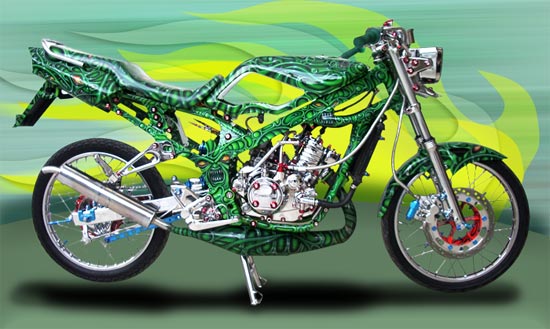
Kawasaki Ninja - a radical modification of the neat and steady for oprasional.

"It looks expensive bgt, whereas if we'd be dibandingin more than Japan should modif motor, lots of crazy modif the price exceeds the price of Aprilia. but cuman doang models which all have the Aprilia Mito.Upside or down, gedhe tires, etc.. "- by Girifumi

Create crazy bro modif Girifumi assumption may be a bit much to make them mengerinyitkan forehead. But for most bikers, especially for bikers who think economically and bikers that prioritizing originality factor may very Girifumi bro assumption is correct.

Cost Factor

An example is the owner of Honda Tiger Revo (nyari safe mode-on), regardless of the cost of the average motorcycle owner modification goal was not far from the model SP NSR, Aprilia or Cagiva Mito. Even beyond the standard may modify them by replacing the light front leg into the foot upside down, the rear suspension to monshock to buy parts like fuel tank parts and the rear panel. Finally, after the modification with the cost of not less be a motor Tiger Revo is a bit like Aprilia, or SP with oddities here and there. The most severe is a radical modification of saving package style, intended to make cost savings, it is the waste and wasting time. Why? Many incidents where the motor modification costs became more expensive than the cost of buying a motor "original" that the goal of modification, is it even a strange hasilnyapun.

Originality factor

This is probably the most controversial paragraphs ever posted in INDOBIKERS. There is a question that is quite intriguing. Does the costume Barcelona numbered 14 you have to be Thierry Henry? Of course not, but certainly you have stated to anyone especially to people who see you that you are a fan or at least sympathizers of the former king of Arsenal. Bahakan if Thierry Henry "original" yes definitely saw you too will smile with you. But by installing fairing Yamaha R1 on the Tiger Revo you, and you happen to run into a real Yamaha R1 would certainly different situations. Maybe nothing happened seemingly anything but actually the driver will only R1 confusion with which you ride motorcycles, often bahakan who scorn it out in the mind of the driver R1 "authentic" is. Besides, whether by using R1 and the fairing you may be necessarily anggot club R1? Unfortunately it's not going to happen but certainly you will lose motor identity.

Creativity without borders

Modifying the motor is the development of creativity without boundaries. But the best pure goal is to modify the original idea, do not imitate or trace moge existing, let alone trace CBU motor sport that costs not much (about the same cost-red) than the price of your own bike. What is clear radical modification of the motor is generally less suitable for daily use. Because like any of the conditions most appropriate motor standarlah used for daily oprasional. If still want to modify the bike but with the condition should be used as a vehicle steadily oprasional daily, the best option is to make minor modifications. Changing tires, veld handlebar and the front or Menganti sockbreaker color and striping pattern into the most appropriate choice. Good luck!